|
|
PhoenixSwarm
5.1.4
Library to ease communication between daemons
|
|
|
PhoenixSwarm
5.1.4
Library to ease communication between daemons
|
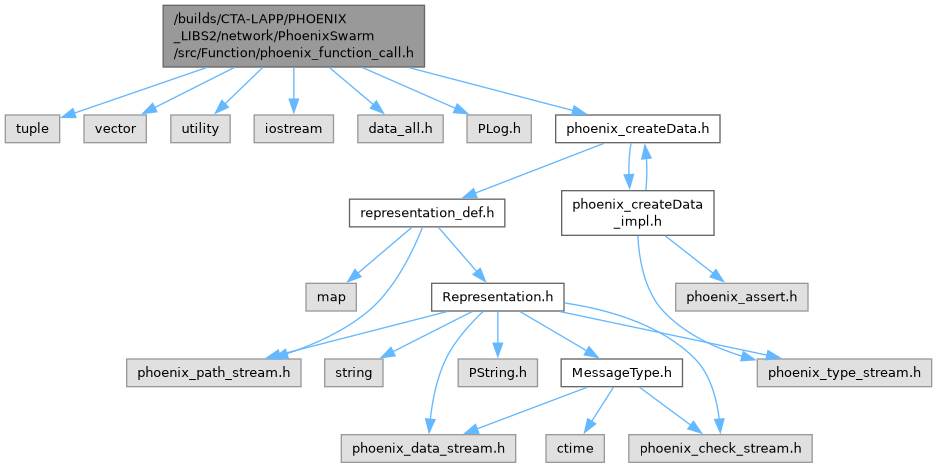
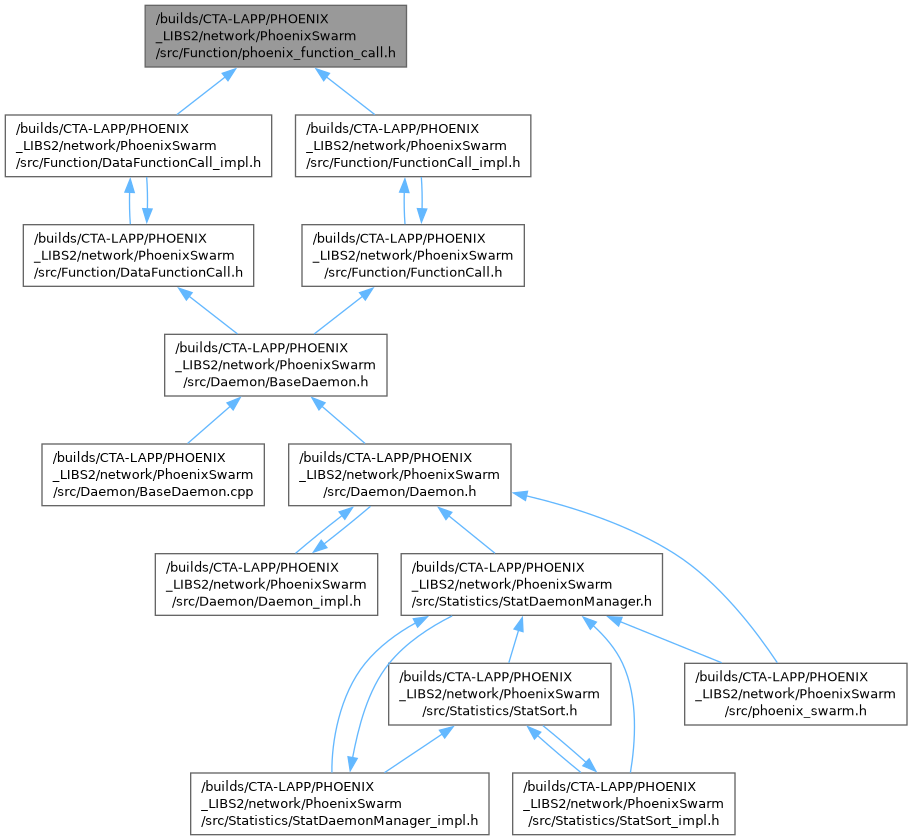
#include <tuple>#include <vector>#include <utility>#include <iostream>#include "data_all.h"#include "PLog.h"#include "phoenix_createData.h" Include dependency graph for phoenix_function_call.h: This graph shows which files directly or indirectly include this file:
Go to the source code of this file.
Classes | |
| struct | static_for_deserialise_message< First, Last > |
| Iterate over function parameters. More... | |
| struct | static_for_deserialise_message< N, N > |
| Iterate over function parameters (end) More... | |
Functions | |
| template<typename R, typename... T> | |
| bool | phoenix_function_call (PLog &log, Swarm::Data &result, const DataStreamMsg &input, R(*func)(T...)) |
| Call the function with message. | |
| template<typename... T> | |
| bool | phoenix_function_call (PLog &log, Swarm::Data &result, const DataStreamMsg &input, void(*func)(T...)) |
| Call the function with message. | |
| bool phoenix_function_call | ( | PLog & | log, |
| Swarm::Data & | result, | ||
| const DataStreamMsg & | input, | ||
| R(* | func )(T...) ) |
Call the function with message.
| [out] | log | : logger |
| [out] | result | : result of the function call |
| input | : input parameters of the function | |
| func | : function to be called |
Definition at line 57 of file phoenix_function_call.h.
References phoenix_createData().
Referenced by Swarm::FunctionCall< _Callable >::call().
Here is the call graph for this function: Here is the caller graph for this function:| bool phoenix_function_call | ( | PLog & | log, |
| Swarm::Data & | result, | ||
| const DataStreamMsg & | input, | ||
| void(* | func )(T...) ) |
Call the function with message.
| [out] | log | : logger |
| [out] | result | : result of the function call |
| input | : input parameters of the function | |
| func | : function to be called |
Definition at line 83 of file phoenix_function_call.h.
References Swarm::Data::setType().
Here is the call graph for this function: 1.13.2